
Caterina Mete Talks The Wiggles and Raising the Next Generation

Hélène Calderin
Writer
August 10, 2026
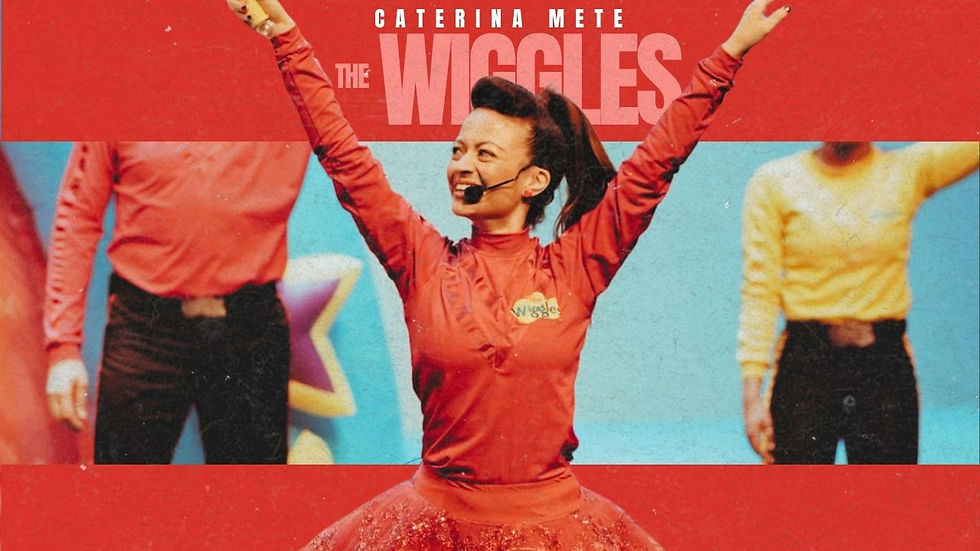
Children’s television is in a very different place than it was when Caterina Mete first joined The Wiggles in 2003. Streaming has changed how families watch, short-form content has become a bigger part of children's media and parents have more control over what their kids are watching and for how long. After 23 years with The Wiggles, Mete has had a front-row seat to that shift, first as a dancer and choreographer and now as the Red Wiggle.
“I started off as a good friend of Dorothy the Dinosaur and then I became a choreographer and now I’m a Red Wiggle,” Mete says.
Her career with The Wiggles began with something she had loved since childhood, performing. She grew up going to dance school and knew she wanted to pursue it professionally. When an audition for Dorothy the Dinosaur came up, she took the opportunity, eventually finding a long-term place within the group.
“The nice thing about the Wiggles, it’s such a wholesome company that if you’re a nice person and you do a good job, then you’ve got a long longevity there,” she says.
That longevity has allowed Mete to see The Wiggles from almost every side. She has performed inside the Dorothy the Dinosaur costume, worked as a dancer and choreographer, and now succeeds Murray Cook as one of the Red Wiggles, performing alongside Simon Pryce.
Live performance, she says, is where she feels best.
“Being on tour and doing live shows is probably my favourite thing about being a Wiggle, because you get the firsthand response,” Mete says.
Surprisingly, the response from American audiences has been the biggest shock for her. Mete estimates she has personally traveled to the United States more than 30 times, while The Wiggles have performed there around 50 times. She remembers the engagement of American children and how enthusiastically they react when they connect with something.
“Americans are so passionate and vocal,” she says. “if they love something, they really love something, then they’re going to tell you about it.”
That immediate interaction is something children's television cannot quite replicate elsewhere. A child watching at home can sing along or dance around the room, but a live show turns that participation into a bond with thousands of other families.
That idea of participation also sits at the center of the way The Wiggles approach music.
Mete does not see children's music as something that needs to be simplified for its audience. The group moves between classical, folk, rap and rock while incorporating instruments including violins, cellos and flutes.
“We’ll have a classical piece, we’ll have a folk song, we’ll have even rap songs,” she says. “So it’s just a variety.”
For young listeners, that variety can become an introduction into the vast world of music without feeling like one. Children can hear different instruments, genres and cultural influences simply by following along to a children’s song. Mete has performed Italian songs connected to her own heritage, while other members have brought music from African, Greek and Filipino backgrounds into the group's work.
“It’s nice to bring those cultures in from the music to our audience too,” she says.
That exposure is part of what makes The Wiggles more than a source of entertainment. Music becomes a way for children to encounter different sounds, cultures and forms of expression while they are still developing their own interests.
Mete sees that relationship with music in her own children as well. Her twin toddlers are constantly listening to songs and stories through devices such as the Toniebox and Yoto. Their interests move between different shows and creators, including Miss Rachel, Mickey Mouse, Teletubbies and The Wiggles.
It is a remark that says a lot about the current children's media landscape. Even inside a household where their mother is a Wiggle, children are growing up with an enormous range of entertainment available to them. But the competition is no longer between just television programs. Music, streaming, YouTube and interactive audio all have a place in the way children spend their time.
Mete expects short-form content to become an increasingly important part of that landscape.
“I think a lot of it will be short form,” she says, explaining that shorter episodes can keep children engaged while also giving parents more control over screen time.
At the same time, she understands why parents sometimes need something that lasts a little longer.
“Sometimes parents want a longer show because they know that if the show is good and entertaining and educational to their child, it gives parents some time to themselves while supporting their child’s development.” she says.
As a mother, that perspective is especially relevant to Mete. She is not only performing for children; she is raising two of them while navigating the same media environment as the families watching The Wiggles.
Her daughters' relationship with music also extends beyond television. They listen through audio players, choose their own songs and dance along to different versions of familiar music. One of their current favorites comes from Lenny Pierce, the twin brother of Purple Wiggle John, who creates dance versions of children's songs.
For Mete, that is part of what makes music so useful for children. It gives them something to participate in rather than simply something to consume.
The Wiggles have also spent years making sure that their music can reach beyond the boundaries of children's entertainment. Anthony Field's background in the Australian rock band The Cockroaches helped shape the group's musical identity, and some of the band's earlier songs were later adapted for The Wiggles with new lyrics.
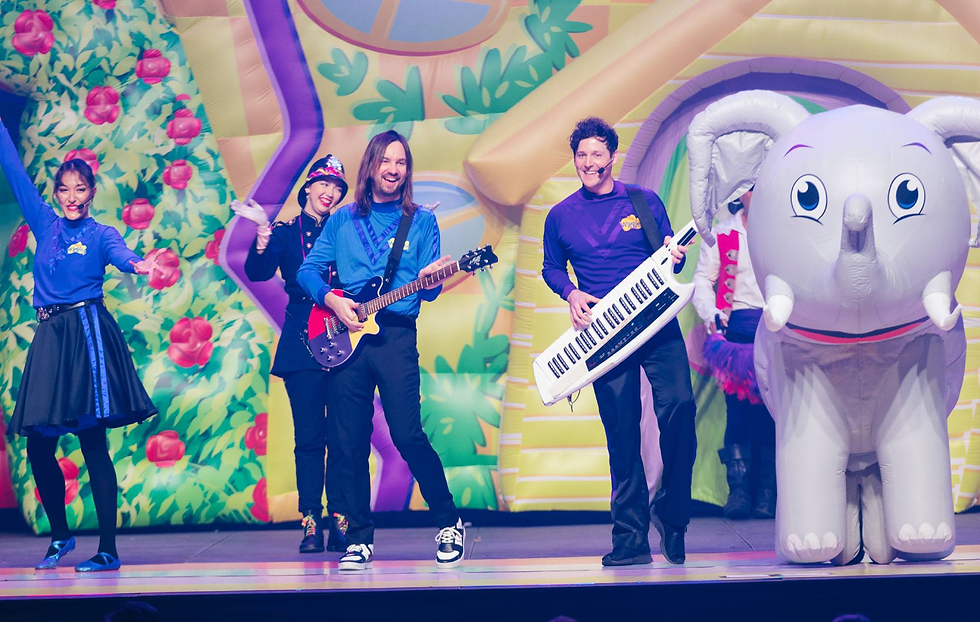
That background has allowed the group to experiment with music that might not traditionally be associated with children's programming. Their version of Tame Impala's “Elephant” eventually won Australia's Hottest 100, a result Mete says the group never expected.
“Never in a million years would they have thought they would have won that,” she says.
The achievement showed that music made for children does not necessarily have to stay within the children's category. The Wiggles can take a modern song, reshape it for their audience and still connect with listeners beyond it.
That same flexibility shows up in the group's television work. Mete talks about recent songs built around everyday activities like doing laundry and trimming hedges, presented with a musical theater twist.
“Everything’s a song,” she says.
For a group built around music, it is an idea that makes sense. Ordinary activities become opportunities to introduce rhythm, movement and creativity, and children can participate without feeling like they are being taught a lesson.
The same approach extends to how The Wiggles represent the people watching them. Mete points to the different ages, cultures and backgrounds within the group and believes children benefit from seeing a range of experiences reflected back at them.
As a single mother, she also understands the importance of showing children that families do not all look the same.
“I’m a solo mum, so I’ve just got me,” she says. “So it’s nice for children to see that families can look different, and that sometimes it’s just mum.”
“There’s all different types of families, all different types of races and nationalities,” she adds. “And I think it’s important that children see that.”
Mete's own place within The Wiggles has followed that same idea of growth. She has moved through different roles over more than two decades, eventually becoming the Red Wiggle and taking on a much more visible relationship with the audience.
“I guess being a Red Wiggle is pretty special,” she says. “That’s not something that everyone gets a chance, an opportunity to do.”
Now, she is doing that job while raising children who are growing up in a media environment very different from the one she entered. They can choose what they watch, switch between platforms and listen to music without ever turning on a television.
The Wiggles have had to grow with that audience, but the core of what they do has remained fairly simple: make music children want to hear and give them a reason to participate.
That may be what keeps the group going as children's television continues to move forward. The platform can change, the length of an episode can change and the way a child discovers a song can change. But the experience of hearing something you like and wanting to sing or dance along to it is still there.
After 23 years, Mete is now part of the group responsible for carrying that experience into another generation. Her journey from Dorothy the Dinosaur to dancer, choreographer and Red Wiggle has happened alongside the evolution of The Wiggles themselves. Now, she gets to watch that next generation discover the music while raising two children who are finding their own favorite songs along the way.
For The Wiggles, the future of children's entertainment may not be about competing for the longest possible attention span. It may be about making those few minutes count, and giving children something they can carry with them long after the screen is gone.

Catch The Wiggles live this August on their Tree of Wisdom Spectacular tour, with stops across the U.S. and Canada, including Orlando, Atlanta, New York, Boston, Ottawa and Toronto.

Comments