
The Strokes' Reality Awaits Is Caught Between Innovation and Imitation
Updated: Jul 30

Jade Read / Stephanie Rodriguez
Writer
July 29, 2026
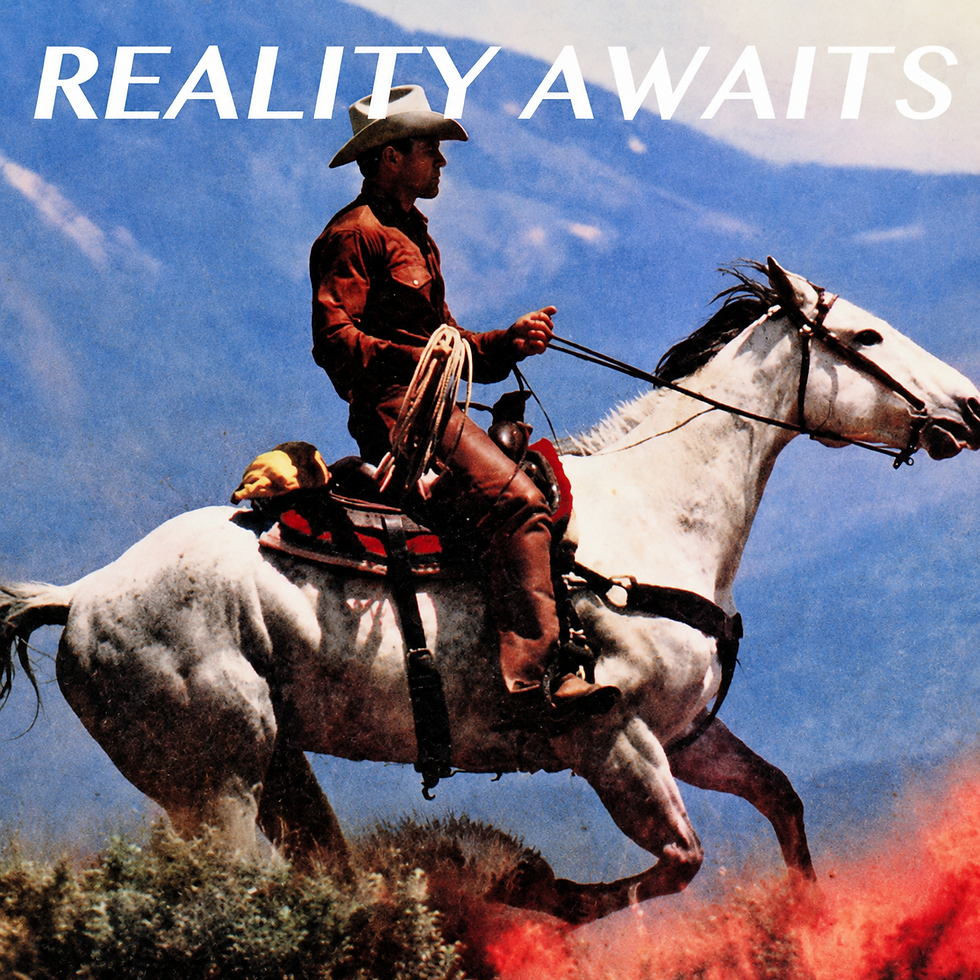
Some albums wear their influences proudly, while others can't seem to escape them. The Strokes' Reality Awaits seems to spend the majority of its time looking to the past rather than creating anything new. Across the record, Julian Casablancas looks back at the style he's adopted with The Voidz, as well as influences like Radiohead and others, influences that run a little too close at times, overshadowing the songs' attempts at originality.
The album opens with "Psycho Shit." A slow build, the song can easily be compared to Radiohead's "Exit Music (For a Film)." Instead of bringing that clear influence into The Strokes' own style, the song leans so deeply into those ideas that it struggles to become its own. Combined with the heavy, piercing, and unnecessary Auto-Tune, it becomes a slightly shittier imitation of those who came before it.
The record begins to find its footing with "Dine N' Dash." While traces of Radiohead are still apparent, mainly in the melody and overall feel, the song channels the gothic rock and new wave bands that shaped The Strokes from the beginning. It feels familiar without being too derivative, offering a shimmer of hope in an album that otherwise seems doomed to be a letdown.
The clear standout, however, is "Lonely in the Future." Ironically, it is also the song that best illustrates the album's biggest contradiction.
Musically, it is one of the few tracks that pushes forward in both sound and meaning, with an overall feel that is exactly what you'd expect from a mature version of The Strokes. What makes it especially interesting, however, is its lyrical approach, which reveals the central concept that plagues the album in a way that leaves it uncertain whether it was intentional or not.
"Weeknd, I like your outfit,
YOLO, you only live once.
Dude kept the beat "As It Was".
John Legend, that's Josh Groban.
I guess I'm flattered, maybe,
All good, we all steal, baby."
This lyric is meant to poke fun at the endless cycle of influence and imitation within the music industry. Casablancas calls out artists like Harry Styles, Drake, and The Weeknd before saying, "All good, we all steal, baby." It is a lyric caught between self-awareness and sarcasm.
Within the context of Reality Awaits, this line takes on a much clearer meaning. Across the album, the songs repeatedly echo Radiohead's melodies and distinctive style. Whether the band is intentionally acknowledging these influences or making a broader point about the music industry is ultimately up to the listener, though either interpretation shows a problem that persists throughout the entire album.
The lyrics continue with Casablancas taking shots at music critic Anthony Fantano in a way that feels far too defensive. Instead of treating his comments as exactly what they are, critiques from a critic, Casablancas seems oddly surprised by criticism, despite it being an unavoidable part of releasing art in any medium. That reaction is especially strange considering the main criticism he appears offended by, his use of AI-generated artwork for The Voidz's Like All Before You, is one that still holds definite validity when considering the crisis AI generation poses to the arts.
Across the album, there also seems to be a great deal of experimentation with the heavy Auto-Tune that Casablancas has adopted over the years through his collaborations with Daft Punk and his work with The Voidz. On Reality Awaits, however, it is dialed up to the max, making it more of a distraction than an addition to the record.
This criticism is most evident on "Falling Out of Love," with the biggest curiosity being what it would sound like if it embraced Julian's unedited vocals. The ballad serves as one of the strongest tracks on the album, but it's hard not to hear the Auto-Tune as almost humorous, sounding more like something made with a vocal changer than a single from one of the most anticipated albums of the decade.
First previewed as "Starting Again," "Going To Babble On" was nearly as anticipated as the album itself because of the following it built through live performances over the years. It is also one of the few Auto-Tune-free songs on the album, largely because it predates the writing of the others by quite a bit, standing alone as one of the more classic Strokes songs here. Even co-written with New Radicals' Gregg Alexander, the song became a staple of anticipation ever since its appearance in New York City mayoral candidate Maya Wiley's campaign ad. Many fans were pleasantly surprised to see the song return, with its outro decaying into itself before spiraling toward a finish that leaves those expectations fulfilled as they leave the oppressive political systems that overbear them to "babble on..."
Back down the slide of declination, "Going Shopping" and "Liar's Remorse" are two of the oddest and most uninteresting songs on the album. "Going Shopping" buries itself under heavily processed vocals, repetitive drum machines, and two fluctuating chords that never really go anywhere. "Liar's Remorse" is, in one word, flat. The vocals once again draw criticism through an odd Caribbean-inspired accent attempted by Julian that lands somewhere between Jason Mraz and a reggae robot. As an overall reflection, the song is nothing new, nothing innovative, and hard to listen to, serving as a basic take on The Strokes' discography as a whole and making it one of the hardest listens on the album.
As one of the least processed songs on the album, the edge and roughness of the band's performance are best shown in "The Fruits of Conquest." Though the lyrics may seem a little all over the place and undefined, the song makes up for it with its noir-esque atmosphere, paired with a far better vocal performance from Julian than what he delivers throughout the rest of the album. Mixed with a dark psychedelic tone that engulfs the track, it becomes one of the stronger songs on the album. The riff also seems to mirror guitarist Nick Valensi's CRX song "Criminals," sharing a nearly identical guitar line.
With a familiar beginning reminiscent of Radiohead's "Faust Arp," "Tyrants of the Mellow Moon" sees its drums push the song into its own territory before it slips right back into Radiohead's turf with a riff that sounds lifted straight from "Paranoid Android." With those comparisons, it's hard to hear the song as anything but bland and heavily derivative. If this weren't The Strokes, you'd probably think it was a local band of Johnny Greenwood megafans taking a stab at pretending to be original, ultimately making the album's closer feel uneventful, bland, dull, and unoriginal.
Ultimately, Reality Awaits feels like an album caught between looking forward and looking back. There are flashes of the band that made The Strokes one of the most influential rock acts of the century, particularly on songs like "Lonely in the Future," "Dine N' Dash," and "Going To Babble On," but they're buried beneath an overreliance on Auto-Tune and songwriting that pulls far too much from its influences rather than building on them. For a band capable of defining an era, Reality Awaits spends too much of its time chasing someone else's sound instead of remembering why everyone else was chasing theirs in the first place.


Comments