
Oasis’ “Don’t Look Back in Anger” Is, in One Word, Biblical


Jade Read
Editor-in-Chief
September 9, 2026
Since 2009, Oasis have found themselves at the close of a chapter, waiting out the years as their anthems lingered across decades, seemingly destined to remain in the past until the day they would meet again. For years, that meeting was considered nothing more than fiction. After all, the Gallagher brothers hated each other, and their deep resentment kept them apart for 16 years, both personally and as a band.
The split left fans distraught. One of the biggest revelations in music since the Beatles had fallen apart, and the people who had given the world some of its greatest songs had chosen not to return to the stage together. To fans, it felt like a betrayal of everything Oasis had given the world. Liam even admits in the documentary that, as a fan, he would tell them to “stick your songs up your f*ckin' arse, you shower.”
Unlucky for Oasis, their fans proved to be one of the most loyal and undying fan bases in music. The demand never disappeared. If anything, the passion only grew stronger with every passing year. Eventually, the weight of that demand became impossible to ignore. The Gallaghers had to put their grievances aside, bury the past and come together once again.
Now, nearly a year after the tour of a lifetime, the story of how Oasis found their way back to each other has made its way to the screen. The documentary takes us back to the beginning, through the years apart and into the reunion itself, giving fans a chance to see how the impossible finally became reality.
The story comes from Steven Knight, who created the documentary alongside directors Dylan Southern and Will Lovelace. Knight, best known as the creator of Peaky Blinders, had already worked with Liam on the 2019 video for “One of Us.” Southern and Lovelace have spent years documenting musicians and the worlds around them. Together, they were given an unusually close look at the reunion, capturing the brothers at their most uncomfortable and letting the tension, awkwardness and emotion speak for itself.
With a reported seven hours of tape captured each day for six weeks, Oasis: Don’t Look Back in Anger was destined to contain some of the most entertaining, unscripted stories behind the band's reunion. The filmmakers could have shown the positives, presenting the comeback as if everything had fallen neatly into place, but they didn’t. They covered the awkwardness and tension of reuniting two brothers who had spent years hating each other before the cameras ever began rolling. The documentary starts with a brief history of the beginning, the middle and the end, before transitioning into the rehearsal space for the reunion, where Noel enters a room ready to make history.
As Noel, Bonehead, Gem, Andy and new drummer Joey Waronker wait in the studio rehearsing the sole-Noel tracks, an enigmatic Liam Gallagher is yet to join. When he finally walks into the room, there is no grand entrance, no introduction and no small talk. He simply walks in and asks, “Are we ready then?” as the tour’s opener, “Hello,” commences.
Whether it was cut or simply not there, the rehearsals show very little casual conversation between Liam and the others, staging him as almost untouchable throughout the documentary. At first, there is a clear tension being worked through song after song, eventually easing into the realization that they were ready to take on what would become some of the most boisterous crowds the band had ever seen. In one clip, Cardiff police are briefed on what to expect for the tour's opener, comparing the characteristics of the fans to “a football crowd,” showing just how much loyalty and ambition went into getting a ticket to see the brothers live.
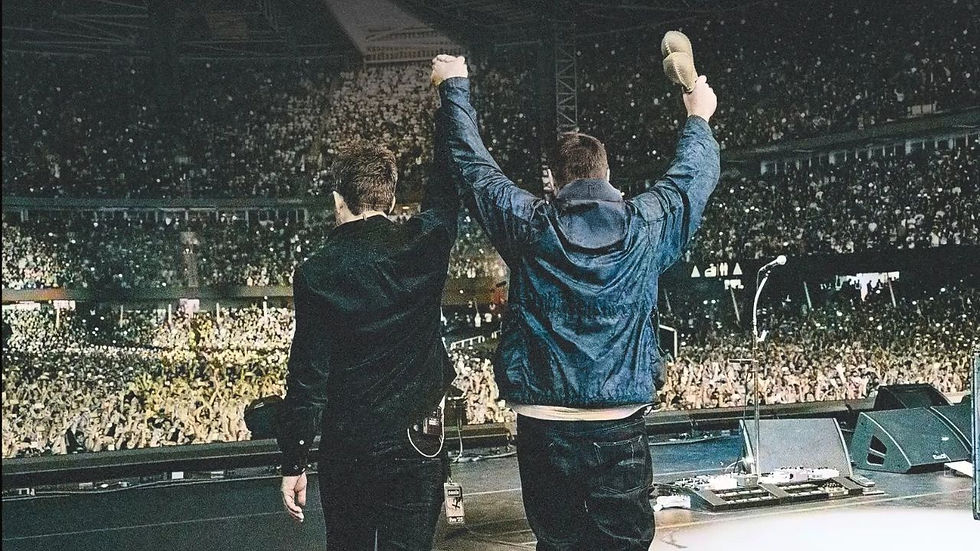
As fans rushed into the Principality Stadium in Cardiff, the readiness of the Gallaghers was seen in two different ways. Noel waits by the stage entrance, lighting a cigarette nervously as he awaits the reaction of the crowd. Liam arrives at the last second, leading the band onto the Welsh stage and embracing the anxious fans, some of whom are reduced to tears at the sight of the reunion. Noel looks back toward the entrance, admitting he was nervous and believing Liam was too, in his own way.

Those tensions surely eased as the tour took on 41 dates across 14 countries, covering Europe, North America, South America, Asia and Australia. As the tour went on, the band found themselves embracing each new continent with a sense of disbelief, realizing they hadn’t understood just how much they had grown since their falling out. This was particularly surprising as they embarked on the North American leg of the tour, a side of the world where Oasis had always fallen short of mainstream dominance. This time, they sold out nine stadium dates across five major cities.
The revelation of just how big Oasis had become did not stop with the Gallaghers. It seeped into the narration of a Burnage church priest, where the brothers were once baptized, now embodied in a sermon on the importance of forgiveness and what it provides to the world through song, passion and togetherness. Alongside the many smaller narratives surrounding the band's importance in the daily lives of their fans, it becomes a portrait of the impact a band can have on the people who believe in them.
Throughout their entire tenure, Liam Gallagher has always referred to himself and the band as “Biblical,” but only now does it become apparent why. The band represents the loyalty of a religion, the anticipation of a rebirth of hope and what it means to put aside hatred for the love of music. The global impact of Oasis is represented in many ways, but perhaps best when the film hones in on individual fans and what the band means to them.
There is the survivor of the Manchester bombings. The San Lorenzo ultras, who have used Oasis songs as the basis of their anthems for nearly a decade, finally seeing the band in their country. A mother whose non-verbal son finds a deep love for “Talk Tonight.” The free diver from Jeju Island in South Korea who used “Acquiesce” to recover from depression. The Mancunians who hopped the fence at Heaton Park, embodying the spirit of where Oasis came from and who they have always been.
That spectacle of larger-than-life humans that is Oasis is held to such a high standard that the band barely seems to recognize it themselves. Noel, for one, addresses the comparison that sees the band in almost saint-like terms to the religion they created, suggesting Liam's ritual of balancing a tambourine on his head resembles the half-halo behind a saint's head in a religious painting. He also recognizes who can pull it off and make it mean something, saying, “If I did that, I’d look like an utter cunt.” Then he admits, “But when he does it, it’s the greatest thing I’ve ever seen.”
And as big as the Gallaghers' egos are, they no longer look at this from some high horse. They look out among the fans, arm in arm, doing the Poznan to “Cigarettes & Alcohol.” They have grown from the angsty, god-like perceptions of themselves into the realization of what the world has given them and what they owe back.
With that, Oasis: Don’t Look Back in Anger becomes the spectacle expected of a documentary about the greatest comeback tour in history, but it is also something more: a statement on the power of music, the strange permanence of fandom and the ability of two people to put aside years of hatred for something bigger than themselves.
And in all its definition: BIBLICAL.

Comments